

August 2009 remains a memorable moment in the history of athletics, especially sprinting. That was when Jamaican sprinter Usain Bolt’s star rose once again on the world stage, as he broke both of his own world records, set a year earlier in the 100 and 200 metres, within just four days. In 2012, he also competed in the 4x100 m relay at the London Olympics, where his team set a new record.
Read more: Yordan Yovchev – legendary athlete and responsible activist
Because of these achievements, Bolt was called “the fastest man in the world” and, alongside his name, earned the nickname “Lightning”—at just 21 years old. But an even greater achievement for the athlete is that, 10 years later, his records remain unbeaten and his titles are just as relevant, even though one of the greatest athletes of this century ended his celebrated career a year ago.
But what did these achievements cost the Jamaican sprinter, and how does he train to successfully conquer the sprint track?
The story of “the Jamaican Lightning”
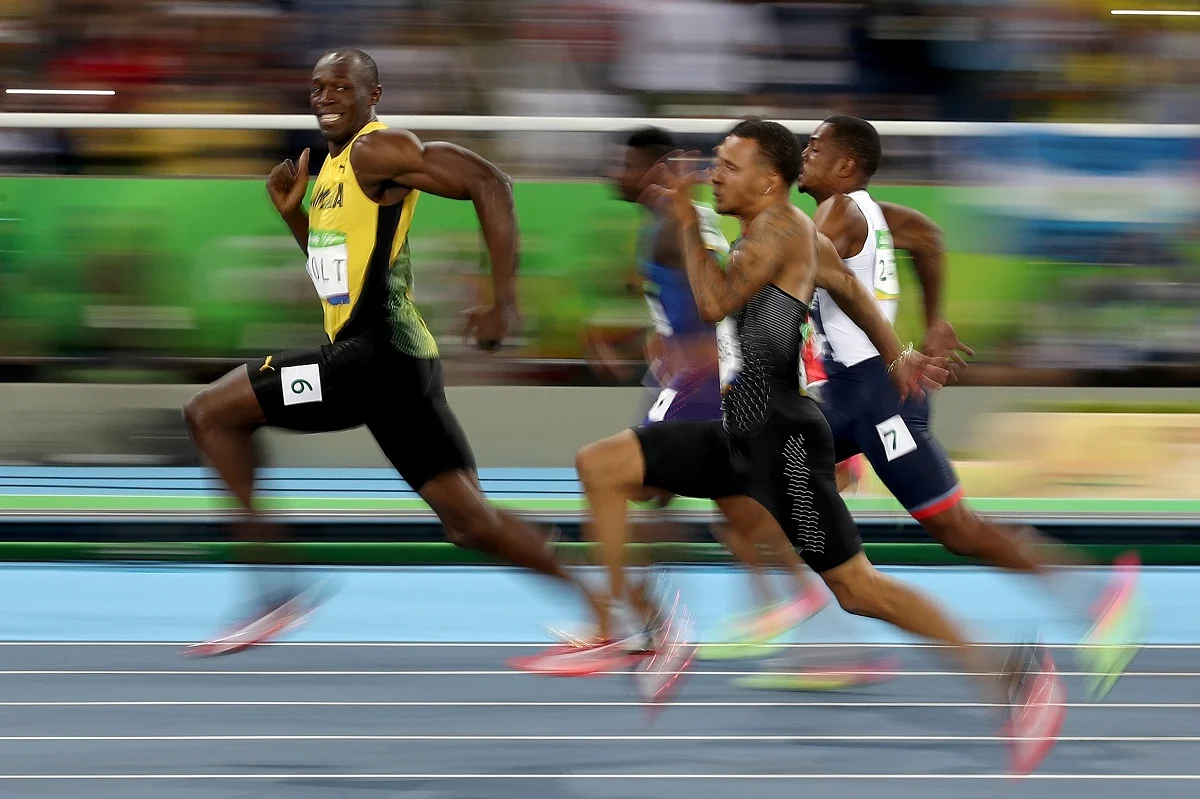
A multiple Olympic and world champion in short-distance running—little more is needed to know that this description refers to Usain Leo Bolt.
Although the athlete needs no lengthy introduction, having become known around the world through his achievements, those achievements deserve recognition and attention. Probably the most naturally gifted athlete the world has ever seen, Bolt made history as the first sprinter to win three gold medals at three consecutive Olympic Games.
Read more: Combat sports at the gym: which ones and why?
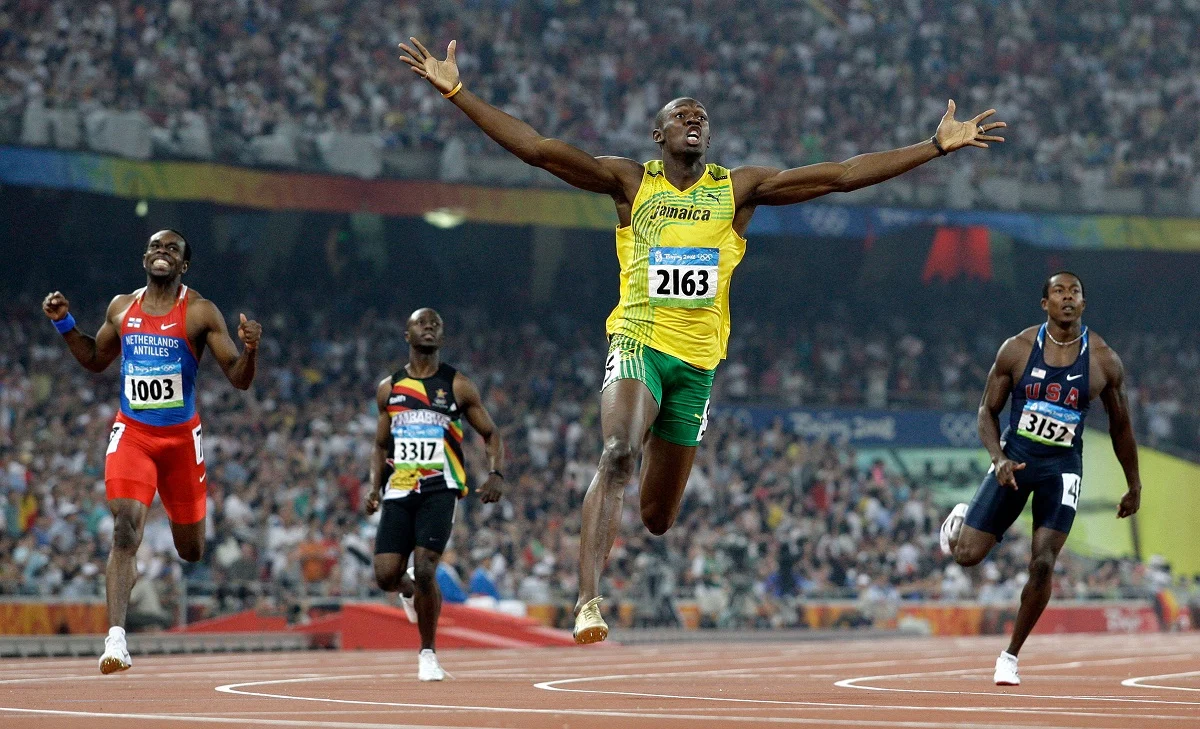
The sprinter’s journey to worldwide fame began at the 2008 Beijing Olympics, where he not only won gold in the 100 m, 200 m and 4 x 100 m, but also set new records in those events. Four years later, he followed up that success with another three gold medals in the same events at the 2012 London Olympics. The day before his 30th birthday in 2016, Bolt achieved the same feat for the third consecutive time at the Rio Games, cementing his place as a legend in world sport.
In addition to his nine Olympic gold medals, Bolt has won 11 titles at the World Athletics Championships in Berlin, Moscow, Beijing and Daegu.
Usain still holds the world records in the 100 m, 200 m and 4×100 m, with times of 9.58 sec, 19.19 sec and 36.84 sec. His first world record was in the 100 meters, with a time of 9.72 sec, set in 2008 in New York. A few months later, he lowered his time to 9.69 sec at the 2008 Olympic Games in Beijing, and then to 9.58 seconds—a time thought unlikely to be beaten for at least another six years. In Beijing, he also set a new world record in the 200 m, covering the distance 0.02 seconds faster than the previous record holder, Michael Johnson.
Read more: Combat sports at the gym: which ones and why?
For his achievements, Bolt has been nominated for and won the Laureus World Sports Award for Sportsman of the Year four times, in 2009, 2010, 2013 and 2017; he was named World Athlete of the Year six times, in 2008, 2009, 2011, 2012, 2013 and 2016, and has received numerous other awards around the world. He also has his own clothing line with Puma, a watch line made by Hublot, the Tracks & Records restaurant in Kingston, Jamaica, the Champion Shave shaving company, a foundation, and more.
How did his sports career begin?
Sprinter Usain Bolt’s first sporting passions were actually cricket and football. He only started doing track and field at the age of 15, after his school noticed how exceptionally fast he was and encouraged him to focus his energy on improving his athletic skills.
Soon after, Bolt won his first silver medal in the 200 m, with a time of 22.04 seconds. Around this time, his coach became Pablo McNeil, a two-time Olympic runner.
Read more: Tips for jogging in cold and rainy weather
Usain first showed his great potential on the world athletics stage in 2002, winning one gold and two silver medals at the World Junior Championships in Kingston. There, he recorded the best 200-meter time of 20.61 seconds.
Two years later, Bolt “broke” the junior world record in the same event, running the distance in 19.93 seconds at the CARIFTA Games in Hamilton, Bermuda. This achievement qualified him for the 200-meter final at the 2005 World Athletics Championships in Helsinki, but he missed the event because of the damp weather, after suffering an unpleasant bone-related injury a few months earlier.
Before long, more success followed. In 2007, at the Jamaican Championships, Bolt improved the national 200 m record by 0.11 sec—a record that had stood for 36 years. More achievements followed, until Bolt became the fastest man on the planet.
How does the fastest man in the world train?

Usain Bolt believes that everyone on earth can run very fast. “There are no secrets,” he says. “You simply need to develop strength, power, acceleration and technique.” Since his specialty is sprinting, it requires a lot of muscle strength and explosiveness (the ability to reach maximum strength very quickly).
Read more: The Anatomy of Kinetics: Facts About Human Strength
To prepare his body, Bolt spends 90 minutes a day at the gym doing full-body exercises that improve his speed, agility, flexibility and functional muscle mass. These include:
- Side plank (3 sets, with 30 seconds’ rest)
- Lying leg raises (3 sets, with 30 seconds’ rest)
- Bunny hops (5 sets of 20 reps)
- Box jumps (4 sets of 8 reps)
- High-knee running (3 sets of 10 reps)
- Cable hip extensions
- Fast stair or platform climbs with weights
- Dumbbell lunges
- Barbell squats
- Frog jumps
Alongside his 90 minutes a day at the gym to stay in top shape, Bolt spends another 90 minutes on the track. His intensive training sessions are followed by a massage and relaxation for full recovery.
What diet does Usain Bolt follow?

It’s no coincidence that Usain Bolt is considered one of the few naturally gifted athletes in the world: he achieved his record-breaking results without taking any supplements, relying instead on good training and diet.
His diet consists of high-energy foods, with 60% protein, 30% carbohydrates and 10% fat. Chicken, pork and fish are the mainstays of his menu.
Read more: Proteins: What Do We Need to Know About Them?
One of his favorite foods is yam, also known as the Mexican sweet potato. It contains plant (phyto)hormones similar to human hormones, which help relieve symptoms of hormonal imbalance. Yam is also known for its tonic, hormone-balancing and rejuvenating properties.